

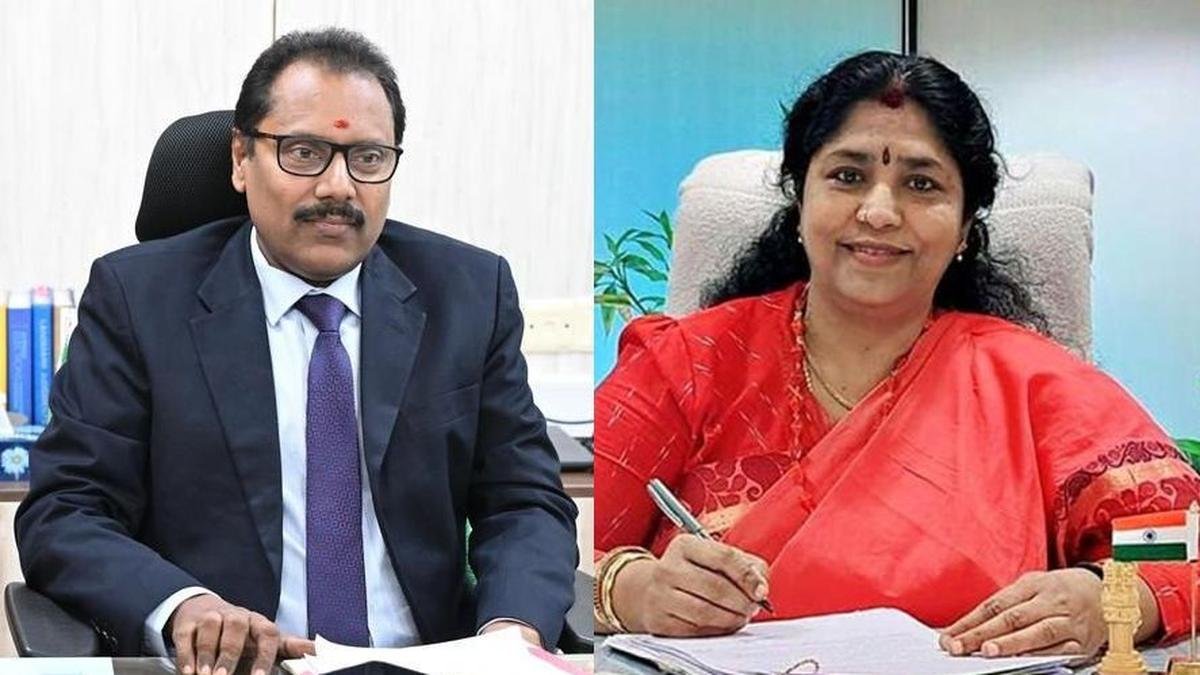
A combo picture of Kerala’s SEC nominee N. Seshadrinathan and Tamil Nadu’s SEC B. Jothi Nirmalasamy. File
| Photo Credit: The Hindu
Two recent developments in Kerala and Tamil Nadu have put the office of the State Election Commissioner in focus. The controversies have also revived discussions on the constitutional provisions governing the appointment and removal of State Election Commissioners.
In Kerala, the nomination of N. Seshadrinathan by the United Democratic Front (UDF) government has drawn opposition from Kerala Pradesh Congress Committee (KPCC) general secretary P.M. Niyas. He has demanded that the Home Department examine intelligence reports on Mr. Seshadrinathan, alleging that he is a “Sangh Parivar activist”. Mr. Seshadrinathan, a retired District Judge, had served as a judge of the Central Bureau of Investigation (CBI) Court in Ernakulam and as the Principal District and Sessions Judge, Kavaratti, Lakshadweep.
In Tamil Nadu, the C. Joseph Vijay government has asked State Election Commissioner B. Jothi Nirmalasamy, a retired Indian Administrative Service (IAS) officer, to step down from her post.
Role, appointment and removal
The State Election Commission (SEC) is a constitutional and autonomous body responsible for conducting free and fair elections to local self-government institutions.
The role of the SEC includes conducting elections to Panchayats and Municipal bodies in the State, supervising the preparation, revision and updating of electoral rolls (where provided under State law), and issuing election notifications, schedules and guidelines. It ensures free and fair elections and enforces the Model Code of Conduct for local body elections. The SEC also oversees nominations, polling, counting of votes and the declaration of results. They also carry out delimitation of constituencies for local bodies before elections. Election-related disputes are dealt with under the mechanism provided by State laws, usually through designated courts or tribunals.
Under Articles 243K and 243ZA of the Constitution, the State Election Commissioner is appointed by the Governor. The conditions of service, tenure and qualifications of the Commissioner are prescribed by State laws, ensuring a formal legal appointment process. The Constitution provides that the State Election Commissioner can be removed only in the same manner and on the same grounds as a High Court Judge, safeguarding the independence of the office.
The Constitution does not prescribe uniform qualifications for the post of State Election Commissioner. As a result, the eligibility criteria vary across States. While some States appoint retired High Court judges, others appoint retired IAS officers or officers from other services. No specific or exceptional qualifications are prescribed for this constitutional post.
In Kerala, the State Election Commissioner is one of the members of the Delimitation Commission of India, set up under the Delimitation Act, 2002, to delimit the boundaries of Assembly and Lok Sabha constituencies in the State. The State Election Commissioner is the Chairman of the State Delimitation Commission constituted from time to time, to delimit the constituencies of Panchayats and wards of Municipalities and Municipal Corporations in the State.
In the Tamil Nadu Delimitation Commission, the State Election Commissioner serves as the ex-officio Chairman and leads the Commission. They oversee the redrawing of local ward boundaries and the determination of elected seats to ensure fair and equal representation across all urban and rural local bodies prior to elections.
Published – July 09, 2026 02:58 pm IST