

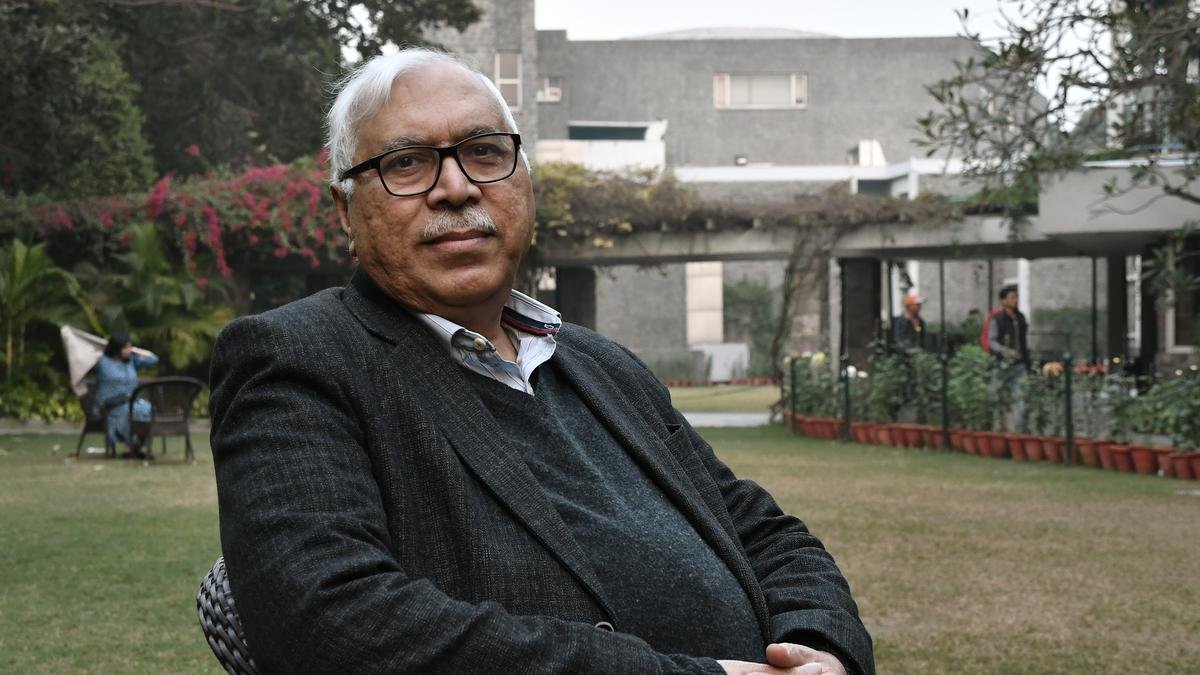
Eight countries of South Asia, Afghanistan, Bangladesh, Bhutan, India, the Maldives, Nepal, Pakistan and Sri Lanka, are home to 25% of the world’s population, and 40% of the world’s democratic population, says former Chief Election Commissioner S.Y. Quraishi. As he traces the origin and evolution of democracies in South Asia in his latest book, Democracy’s Heartland: Inside the Battle for Power in South Asia, Quraishi also questions why the region is almost exclusively identified with India. In an interview, he also claims that the recent Gen Z agitation in Nepal was not against democracy, but that it was a demand for more democracy. Edited excerpts:
Question: In your book, you argue that South Asia or South Asian democracy is not only about India. There are numerous other countries where democracy has worked very well.
There is a reason why I call the book, ‘Democracy’s Heartland’. It’s because I found that the eight countries which comprise ‘South Asia’ have 25% of the world’s population and 40% of the world’s democratic population. Yet, people do not realise the importance of this region for democracy and hardly anything has been written about it. There is no attention to this from the political world. Similarly, in academic discourse, when they do research, they hardly talk about South Asia. Everywhere, in almost all universities, there is a South Asia India division, but when they talk about South Asia, 99% of it is about India.
Why is the spotlight always on India? The other countries think India is a big brother. Although it is not our fault that we are the biggest country, we have a vibrant democracy and, therefore, we have every reason to be proud of our democracy. But at the same time, we are hogging all the limelight. It’s not what we do intentionally, but others make this mistake of only focussing on it.
But over the last couple of years, beginning with Sri Lanka, Bangladesh, and now Nepal, there have been mass protests. Why are these countries facing such issues?
Yes, South Asian countries have been facing issues, but mostly, the reports have highlighted the negative things — about protests and regime changes. But the focus should have been on studying democracy, and the trends.
In Sri Lanka, Bangladesh and Nepal, it was a people’s protest against corrupt regimes. It was a fight against corruption and nepotism, and many people say that this is an attack of democracy. I have a different view. They are not attacks on democracy, it is actually an assertion of democracy. These people do not want to kill democracy. They want more democracy. They want an honest and deeper democracy. The protesters in all three countries remind us of the whistles of a pressure cooker. If you get annoyed by the whistle and seal it, then the cooker will burst.
Apart from the corruption issue, what do you think can be done or what should Nepal address to strengthen its democratic process?
The issue in Nepal has been political instability. In the last 70 years, there have been seven constitutions; in the last five years, there have been five Prime Ministers. This, combined with acute corruption and nepotism, is the issue which has been afflicting Nepal. There was a lot of resentment brewing for a long time. These protests were initially peaceful. The people, especially the youth, were only protesting against corruption and nepotism. The immediate trigger was the total ban on all social media. Social media is like the air around us, particularly in Nepal, where 10% of the people are abroad. Their only line of communication, on a daily basis, whether it is health, education, remittances, is based on that. It’s their lifeline. When it was stalled, the youth could take it no more.
When the youth took out a procession, the police opened fire, and 19 protesters were killed on the first day and scores were seriously injured, and the death toll eventually increased to nearly 70. If you shoot at your own people, things do get out of hand. The youngsters went berserk, and started burning buildings [which housed] important government offices. Some people thought that they were attacking democracy. But to say that it was an attack on democracy is wrong — they were demanding more democracy. You must have noticed that the same protesters came out to clean up the mess. Also, when the question of leadership came, none of the youth agitation leaders wanted to be the prime minister; instead, they opted for PM a former chief justice, the only woman to hold the post.
Why are things different in India? What is the reason behind the resilience of Indian democracy?
India has been more sensible and more responsible. When the establishment sees people protesting, it negotiates, it talks to them and tries to calm them down. India understands that being watchful of the early warning signals is very important and takes immediate corrective action. Addressing the grievances of the people, particularly of the youth, has to be done in time.
Would you say that Indian democracy has evolved in a positive manner and is more matured now?
Yes, indeed. There are pitfalls of course, but the fact is that in India, for 75 years, we have had elections on the dot, with clockwork precision. India is not only the biggest democracy, it is virtually 90 countries rolled into one. It is like all 50 countries of Europe plus North America going to polls at the same time. Yet we conduct elections peacefully with finesse and perfection. Not once have our elections been questioned, and every time the transition of power has been very seamless. That is the intrinsic maturity of our democracy.
Of course, there are some issues like criminalisation of politics, and very poor representation of women in our legislatures. That is why in some global indexes of democracy, we are not counted as a full democracy. The Economist Intelligence Unit in 2024 shows us as a flawed democracy. When I came across this categorisation, my first reaction as an Indian was of anger and hostility. I took it as a western conspiracy against India, where they created parameters which showed India in a poor light. But when I studied the report in detail the reasons became obvious.
The representation of women in Parliament was low; even now it is around 15%. We have issues of corruption and illiteracy. But one positive thing that has happened recently is the passage of the long-pending bill for women’s reservation. When it comes into operation in 2029, which I think it will, our ranking will surely improve.
You trace the evolution of Indian democracy since the time of the British Raj. Would you say Indian democracy has matured? How do you compare the process with other South Asian democracies?
Most democracies in South Asia were born out of freedom movements. It’s a pity that there is very little knowledge about South Asia, unlike India. For instance, do you know that the first democracy in South Asia was Sri Lanka which adopted universal adult franchise as far bar back as 1931 while India did it in 1950? Even many European countries gave equal voting rights in late 1940s. Secondly, Sri Lanka also has the distinction of having the first woman prime minister in the world – in 1960.
You have travelled and studied democracies in many countries across the world, including the U.K. Many of these countries are facing protests against immigrants. In that context, what is the future of democracy in the world?
I was on the board of the Institute for Democracy and Electoral Assistance, Stockholm, for nine years. Every two years, it comes out with a report on the state of democracies in the world. And it found that democracy worldwide was actually in decline. At the same time, there was hope, as many countries showed resilience and determination to bounce back. These ups and downs are a normal phenomenon in the world. As regards immigrants, the protests are bound to grow worldwide with shrinking job opportunities, and mechanisation and artificial intelligence compounding the problem. We must have a strategy in place to deal with this serious threat.
Democracy’s Heartland: Inside the Battle for Power in South Asia
S.Y. Quraishi
Juggernaut
₹799
Published – September 24, 2025 02:19 pm IST