

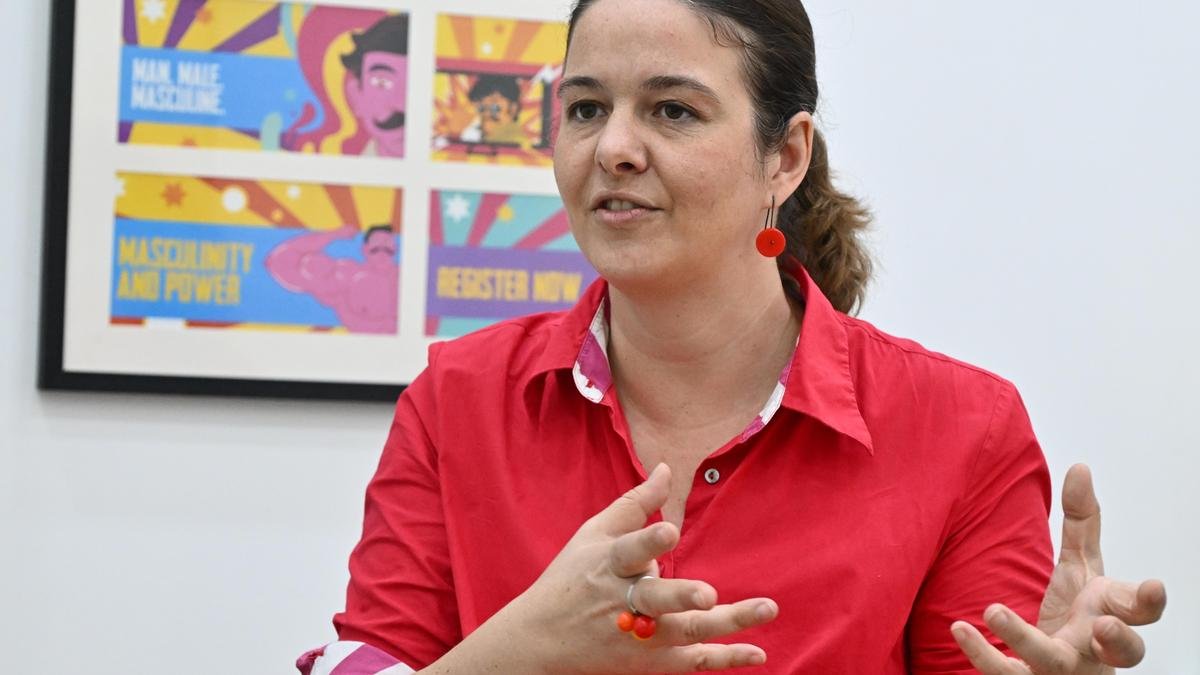
Katharina Görgen arrived in Chennai in August 2020 at the height of the COVID-19 pandemic, to take over director of Goethe-Institut Chennai. “For almost two years, no one even knew that Goethe-Institut had a new director, as we had suspended all events and even our German language classes were offered online,” says Katharina.
Now, as her six-year tenure comes to an end, and she prepares to start work at Goethe-Institut in Kraków, Poland, Leonhard Emmerling will take over as director of Goethe-Institut Chennai. An art historian, curator and author, Leonhard previously served as director, Programmes for South Asia at Goethe-Institut/Max Mueller Bhavan in New Delhi and has led Goethe-Institut centres in Chicago and Houston. His plan for the years ahead involve building on the institute’s legacy while forging new conversations with Chennai’s cultural community.
Sparking a feminist discourse
Katharina’s tenure has been marked by a strong commitment to feminist discourse and practice. She conceptualised and supported several flagship projects, including exhibitions, residencies and interdisciplinary programmes. “I am particularly proud of having built a strong network during my tenure, especially with the Chennai Photo Biennale, DakshinaChitra, Tara Books, Alliance Française and SNS Consultancy. I also enjoyed putting together The Little Lit Festival, the International Children’s Literature Festival 2.0 (2025),” she says.
She adds that her biggest challenge was finding common ground. “The concept of public art is yet to be firmly established here, but there is immense scope for exploration. Public spaces are ideal for art to reach a wider audience. People may hesitate to enter an art gallery or even Goethe-Institut, but they may have no such inhibitions about engaging with art in public spaces,” she states.
The Goethe-Institut has seen an significant increase in enrollment for in-person classes in recent months. “After the pandemic, most people preferred online classes. However, I think many now choose to step out of their homes and attend classes in person, as it provides an opportunity to meet and interact with like-minded people,” she says, adding that she also facilitated a sign language course.
Katharina Görgen, director of Goethe-Institut Chennai, at her office ahead of her move to Kraków, Poland.
| Photo Credit:
RAGU R
Going local
Inspired by her interest in movement and fitness, Katharina learnt silambam, the traditional Tamil martial art, training twice a week with master Silambarasan while she lived in Chennai. “My predecessor, Helmut Schippert, used to cycle everywhere when he was herei. I explored the city on foot and would simply walk to all the places I intended to visit,” says Katharina. “In recent times, I have especially enjoyed walking along Khader Nawaz Khan Road, which has undergone a complete transformation.”
Katharina Görgen, director of Goethe-Institut Chennai, at her office ahead of her move to Kraków, Poland.
| Photo Credit:
RAGU R
Children participating at Children Literature Festival at Goethe Institute in Chennai. File
| Photo Credit:
AKHILA EASWARAN
The road ahead
Rather than arriving with a fixed agenda, Leonhard says his first priority is to listen. “Everything we do at the Goethe-Institut should be based on the idea of dialogue and exchange,” he says, adding that he wants future programmes to emerge organically through conversations with artists, writers, museums and cultural institutions in the city, rather than from preconceived ideas. The final phase of The Female Legacy Project, a multimedia initiative, will be completed under his leadership.
Leonhard Emmerling
| Photo Credit:
Special Arrangement
Having previously served as Director of Programmes for South Asia at Goethe-Institut/Max Mueller Bhavan in New Delhi, Leonhard says he is looking forward to reconnecting with the region through Chennai’s vibrant cultural landscape. He sees the city’s museums, music venues and dance institutions as spaces where conversations around history, aesthetics and the role of art in contemporary society can flourish.
Historian Nivedita Louis singing Gujili paatu, the forgotten songs of Madras at Launch of Madras day celebrations at Goethe- Institut in Chennai. File
| Photo Credit:
VELANKANNI RAJ B
An art historian and curator by training, Leonhard believes museums are far more than repositories of the past. Instead, he sees them as spaces that help societies understand the present by engaging critically with history. The same philosophy informs his understanding of cultural diplomacy, which he describes as an exchange of ideas and values that enriches both sides.
For his first year in Chennai, Leonhard is not looking to introduce sweeping changes. Instead, he hopes to build relationships based on trust, curiosity and mutual respect. His aim, he says, is for Goethe-Institut Chennai to be recognised as an institution that listens first and develops programmes through shared interests, allowing meaningful and unexpected collaborations to take shape.
Published – July 02, 2026 09:14 am IST