
I read a piece of discourse from the Met Gala, one of many, by Diet Prada, the meme account that inspired its Indian sisters, Diet Sabya and Diet Paratha. The headline read: ‘Was Chanel’s outfit for Bhavitha Mandava, racist?’ My thoughts on the look aside, and we will get into them because what is a Met Gala column without a small best-dressed list attached, this year’s event felt as if someone had turned the volume down.
The first Monday in May in New York City is usually a thrilling evening: the guest list, the co-chairs, the beautiful absurdity of watching famous people attempt to interpret a museum brief in couture. My favourite part has always been the exhibition itself. And of course, watching our ever-growing Indian contingent bring their culture on their sleeves.
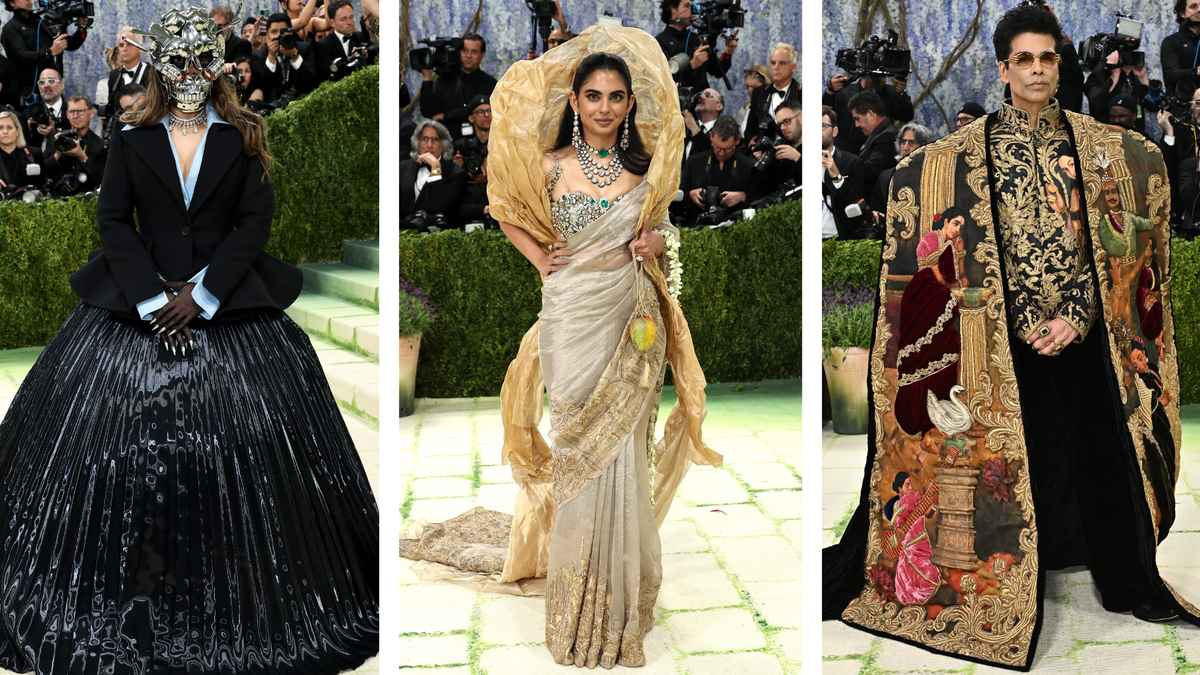
(L-R) Sudha Reddy, Manish Malhotra, and Natasha Poonawalla
This year, in a big win for fashion as art and business, the Costume Art exhibit moved out of the basement and into the new Condé M. Nast Galleries beside the Met’s Great Hall, occupying prime place in public consciousness. Its smartest gesture, from what I have read, is the use of mannequins based on real bodies: ageing, disabled, pregnant, some with mirrored faces that return the viewer to themselves.
But mired in controversy over the involvement of Amazon’s Jeff Bezos and his wife Lauren Sánchez Bezos, the Met Gala — or ‘Tech Gala’, or the ‘Bezos Ball’ as the Internet has now come to call it — had an underscoring discomfort to it, visible even from our phone screens. The vibes were off, Gen Z would say.
Lauren Sánchez Bezos and Nicole Kidman at the Met Gala
| Photo Credit:
Reuters
Whose money should fund our dreams?
On one side of Fifth Avenue, the world’s most famous people ascended the Met steps dressed as living sculptures and hand-painted canvases. On the other, beyond the barricades and flashbulbs, protesters asked who gets to fund culture, who gets to narrate it, and who pays the price when art becomes a billionaire’s calling card.
The gala raised a record $42 million for the Costume Institute. A big win for making fashion serious art and business (and not to mention, Anna Wintour’s own legacy). All of this, it seems, was made possible by the Bezos, with additional support from French luxury fashion house Saint Laurent and media company Condé Nast.
Anna Wintour
| Photo Credit:
AFP
But the Bezos presence produced its own counter-programming around the event — activists staged a ‘Labor is Art’ fashion show in Manhattan, bringing together Amazon workers, unions and supporters, and others objected to the gala’s billionaire patronage more directly. The allegations are hardly imagined — Amazon has faced sustained scrutiny over labour conditions and, more recently, job cuts.
Protesters gathered blocks away from where the Met Gala was being held
| Photo Credit:
AFP
New York City mayor Zohran Mamdani, whose wife, Rama Duwaji, is an illustrator, and Indian-American mother, Mira Nair, is a filmmaker, skipped the event entirely. Instead, he released a fashion portfolio just hours before the Met Gala, honouring garment, retail and warehouse workers, including tailors and former Amazon employees, who keep the industry running. It seemed like a statement.
Zohran Mamdani speaks at a rally on May Day
| Photo Credit:
AFP
The old defence goes that at least billionaires are funding the arts. It’s not an entirely useless argument. Public museums need money, fashion exhibitions cost money. Last October, the British Museum’s inaugural Ball, co-chaired by Indian businesswoman Isha Ambani, raised more than £2.5 million for the museum’s international work. Most major cultural institutions have long relied on the generosity, ego, taste and tax arrangements of the very rich.
Content economy
The Met Gala was never meant to be a private dinner photographed for posterity. It is where business people and philanthropists, designers and artists, pop stars and socialites rub shoulders over art, fashion and access. Vogue’s livestream from the Met Gala this year was broadcast across its digital platforms, including YouTube and TikTok, and the red-carpet replay was presented by brands such as Colgate and eBay. The party raises funds for the Costume Institute, yes, but it also drives a week-long economy of beauty breakdowns, brand placements, reaction videos and red-carpet punditry by editors and paid Instagram commentators alike. In Internet time, one Met Gala night equals months, if not years, of content.
But ever wondered what that does to the clothes? Too often, it produces memetic gestures engineered for screenshots. For instance, Heidi Klum turning up to Halloween a quarter too late. Chanel, under Matthieu Blazy, putting Bhavitha Mandava in a wisp-y, sheer, couture version of the same quarter-zip jumper and jeans we have now seen one too many times.
Bhavitha Mandava and Awar Odhiang attend the 2026 Met Gala
| Photo Credit:
AFP
Virality sells when the whole world is watching, but in the attempt to recreate elusive attention metrics, you can lose the thing you hoped to protect in the first place — taste. I wonder if the same applies to the Met Gala’s relationship with Big Tech. As taste sells out, would the allure of fashion’s greatest night begin to thin, too? As money steps into the frame, could some want to step out?
A cultural display
India, this year though, did show up (and show out!). Vogue India counted 11 Indian-origin celebrities, though depending on how possessive we are feeling, we may also try to claim South African singer-songwriter Tyla (via her Mauritian-Indian father). I watched for subtle references to drapes, sculpture, metal, royal archives and art history. Isha Ambani wore a Gaurav Gupta sari inspired by Raja Ravi Varma’s Padmini: The Lotus Lady.
Isha Ambani
Subodh Gupta’s steel mango bag was on her arm; Ananya Birla donned a sculptural face mask made by the contemporary artist. I loved what Subodh had to say: “When someone wears the work or carries it, it becomes like a performance, they become part of the artwork. At the end of the day, whether it is the Met Gala or a museum, it is still about the experience of art.”
Ananya Birla poses during the Met Gala
| Photo Credit:
Reuters
Ananya Birla’s sculptural face mask
| Photo Credit:
Reuters
As Daniel Rodgers, fashion news editor at British Vogue, once told me, the best Met Gala looks are those that “can ignite the Internet and withstand a more rigorous reading the next morning”. The more specific a story is, the more universal it often feels. Diljit Dosanjh understood that last year, in his feathered turban, Golecha necklace, gilded Prabal Gurung sherwani and tehmat, with the map of Punjab on its back.
Diljit Dosanjh attends the 2025 Met Gala
| Photo Credit:
AFP
This year, Gauravi Kumari understood it in her look by Gurung, which incorporated her great-grandmother Maharani Gayatri Devi’s chiffon sari and pearls in homage to the late royal’s unmistakable style. Sibling Padmanabh Singh brought his culture in a Phulghar coat, the regional silhouette developed with Gurung and realised in Jaipur by a team of experts.
Sawai Padmanabh Singh and princess Gauravi Kumari of Jaipur
| Photo Credit:
AFP
Birla continued the art dialogue after the Gala, first in an Ashi Studio Indian bronze sculpture-inspired metal bodice dress, and then by bringing her family’s revered M.F. Husain painting, The Woman with the Sitar, to a demi-couture dress designed by Harris Reed.
Ananya Birla in a demi-couture dress featuring M.F. Husain’s painting
| Photo Credit:
Courtesy of @ananyabirla
This, to me, is the wonderful paradox of the Met Gala. At its best, it allows cultures to speak with specificity. It can turn a sari, a tiffin box, a mango, a Phulghar coat, a Husain painting, or a pearl necklace into a global conversation. At its worst, it is a gilded room in which power congratulates itself for buying proximity to beauty.
I’m still unsure where I stand on the question of whose money should fund our dreams. The easy answer is that money is money, and museums need it. The harder answer is that money is never only money. It shapes rooms, agendas and always asks to be thanked from podiums.
The column is dedicated to dissecting India’s growing presence around the world, against some of the most talked about cultural backdrops.
The writer is an independent journalist based in London, writing on fashion, luxury and lifestyle.