

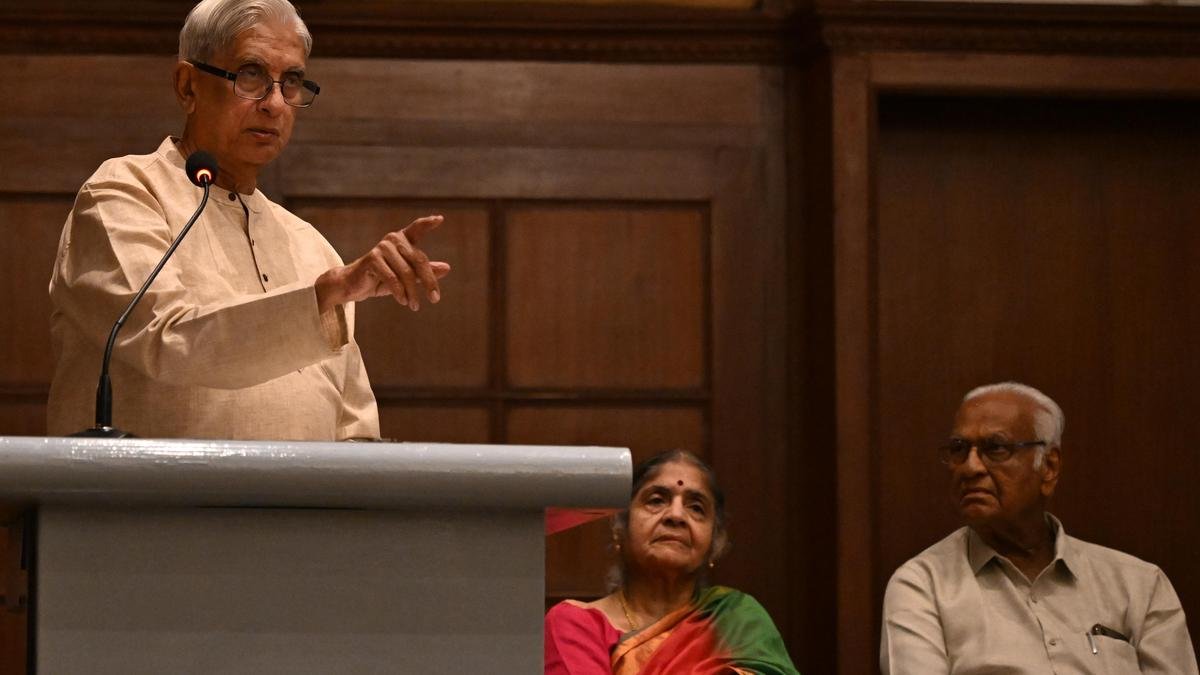
R.K. Raghavan, a Tamil Nadu cadre officer of the 1963 batch, investigated the Bofors case, the match-fixing case in 2000 that saw the ouster of Indian cricket captain Mohammad Azharuddin, the fodder scam of Bihar’s Chief Minister Lalu Prasad, and others. A former Director of the Central Bureau of Investigation, Dr. Raghavan is not only an accomplished police officer but also a writer and academic. In his autobiography A Road Well Travelled (Westland, second edition), Dr. Raghavan, 85, reflects not only on his life, both personal and professional, but also on larger issues such as governance, inter-group tensions in rural areas, criminal justice administration, and representation of minorities in the police forces of the U.S. and India. In a conversation with T. Ramakrishnan, he speaks of his assessment of certain historical events as well as the chronic issues and challenges confronting the country. Edited excerpts:
In your book, why do you blame former Prime Minister V. P. Singh for the assassination of his immediate predecessor Rajiv Gandhi, who did not have the Special Protection Group (SPG) cover then? Was it not a fact then that the legal framework on SPG cover was confined to serving Prime Ministers?
Singh’s withdrawal of SPG was a political decision and unwarranted although technically correct — SPG was intended originally for protecting serving Prime Ministers. However, several commentators would agree with me. This tendentious action was compounded by Rajiv Gandhi’s tendency to flout security norms and the callousness of the Congress in organising the Sriperumbudur rally in May 1991.
However blameworthy Singh may have been, it is also difficult to understand why the succeeding Chandra Shekhar government did not act swiftly to restore the SPG cover for Rajiv Gandhi.
What is your recollection of discussions that you had with Tamil leaders of Sri Lanka in the 1980s, after the anti-Tamil pogrom?
I had the occasion to meet [Tamil United Liberation Front (TULF) general secretary] A. Amirthalingam and [the ideologue of the Liberation Tigers of Tamil Eelam (LTTE)] Anton S. Balasingham, I found them to be suave and communicative. They seemed to be happy that the Government of India was sympathetic. They would, however, have liked us to do a lot more and instantly. That was not to be.
Indians, in general, do not give due importance to field training the way they do to research. In fact, your reference to the quality of the faculty at the Police Training College, Vellore, is an illustration. Why?
You are right about low priority for training as training assignments are low in glamour. I must, however, add that IPS training at the National Police Academy, Hyderabad, has greatly improved. Barring a few State Police training institutes, others are rated poorly.
What should be done to improve the morale of police officers of the Indian Police Service?
The morale of officers in the service is a mixed bag. In some Stares, it is good. In many others, it is not because of poor leadership within the force and blatant politicisation by the executive. We want professional leadership and rectitude in matters concerning investigation and management of over 10,000 police stations in the country.
Let me add that these days, many brilliant and highly promising youngsters with an academic background and technical education are coming into the IPS. At the same time, I am disillusioned with the declining standards of integrity after only a few years in the service. This can be seen in the IAS and other Central services as well.
Why do several high-profile criminal cases collapse? Is it because of lax investigating officers? Or is it due to political interference, a feature that you have frequently mentioned in your book?
Failure of investigation in many major investigations is due to poor police handling and utter lack of public cooperation, compounded in some cases by gross political interference.
Do you want the Intelligence Bureau to be made a multi-disciplinary body on the lines of the Research and Analysis Wing?
I served the Intelligence Bureau for 15 years. I can truthfully say that it is a professional organisation with a highly competent leadership. I don’t see any case for it to be multidisciplinary.
Did you not think it would be a violation of the principle of propriety to accept the assignment as High Commissioner to Cyprus just months after stepping down as the chief of the Special Investigation Team that probed the 2002 Gujarat riots, given that that the then Chief Minister (and now Prime Minister) Narendra Modi had been cleared of charges, even though you believe you carried out your duties in a thorough and professional manner?
I decline to answer this question.
ramakrishnan.t@thehindu.co.in
Published – May 28, 2026 05:32 pm IST