
Jane Schoenbrun has now made three films about people getting thoroughly and spectacularly mugged by the media they consume. Across their debut feature We’re All Going to the World’s Fair, which left its protagonist stranded inside the dissociative sludge of internet horror, and the sophomore gut-punch I Saw the TV Glow, which turned estrangement from the body into one of the most agonising metaphors for gender dysphoria, Schoenbrun has established an unmistakably personal lineage. Now, their latest Cannes-winning Teenage Sex & Death at Camp Miasma completes that unofficial media-nostalgia triptych.
So far, Schoenbrun’s films have luxuriated in the narcotic comforts of mediated worlds, in that forbidden little borderland where movies, television and the assorted digital flotsam of the internet become more intoxicating than ordinary life, especially when you encounter the right piece of fiction at the wrong age. Camp Miasma takes that distinctly Schoenbrun-ian preoccupation of being psychologically colonised by media and lets it loose from the cerebral confines of media theory, towards unbridled horniness. It is, in other words, a movie about cinephilia, i.e. that ancient and incurable affliction of wanting to have sex with a great film.
Kris Williams (Hannah Einbinder) is a 29-year-old independent filmmaker who has been recruited by a studio to revive Camp Miasma, an ageing slasher property whose corpse has already been picked clean by sequels, merchandise and years of diminishing cultural relevance in the tradition of classics like Friday the 13th, A Nightmare on Elm Street and Halloween. Kris is ostensibly being hired because her queer perspective can modernise the franchise and lend it contemporary credibility, which the studio hopes will make the old, problematic piece of intellectual property feel woke enough for a 21st-century moviegoer.
Teenage Sex & Death at Camp Miasma (English)
Director: Jane Schoenbrun
Cast: Hannah Einbinder, Gillian Anderson, Jack Haven, Eva Victor, Zach Cherry
Runtime: 112 minutes
Storyline: After years of slapdash sequels, the “Camp Miasma” franchise gets handed over to an enthusiastic young director for resurrection
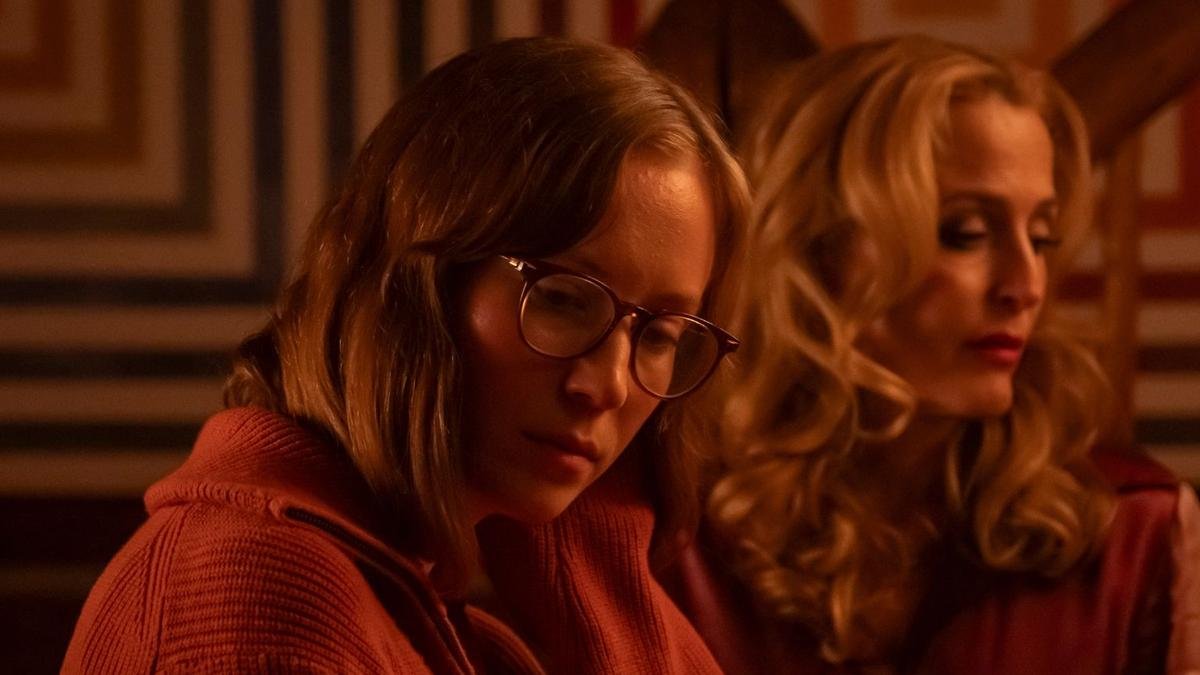
But Camp Miasma means a whole lot more for Kris than just a new gig. She has been devoted to the franchise since childhood, with a particular fascination for Squeak, the young camp counsellor played by Billy Presley in the original. Billy, now portrayed by Gillian Anderson, eventually abandoned acting after refusing to return for the disreputable sequels, retreating to the very location where the first Camp Miasma was filmed. Kris goes there to convince her to take part in the reboot, only for the professional errand to become something much more intimate as the two confront what the franchise has come to mean to each of them, emotionally and sexually.
Named after the French euphemism for orgasm, Little Death is the Camp Miasma franchise’s spear-wielding cryptid — a sexually vindictive apparition who spends its off-season in a hole at the bottom of the water, periodically surfacing to punish campers for the crime of getting laid. Schoenbrun uses the hole in the lake as a versatile metaphor for everything Kris has kept submerged, whether that is horniness, shame, fantasy, terror, artistic ambition, curiosity, the humiliating ache to belong, or all the other psychic junk she has accumulated from trying to intellectualise her desires. The hole is a vagina and a grave, an orgasm and an entrance, a portal into fantasy and a literal puncture in the membrane separating the Camp Miasma movie from the world producing it. It is also, somehow, just a hole in a lake through which a murderous freak occasionally comes climbing.
A still from ‘Teenage Sex & Death at Camp Miasma’
| Photo Credit:
MUBI
Little Death is an especially loaded piece of slasher iconography, because the character’s gender fluidity turns the monster’s genealogy into a little act of reclamation from a franchise history steeped in transphobia. Schoenbrun does not leave Little Death embalmed inside that old prejudice, either. Even the casting has a curious bit of recursiveness: Jack Haven, the trans actor from I Saw the TV Glow, plays the killer, so the performer who previously inhabited one of Schoenbrun’s most intimate stories about estrangement from the body now gets to crawl out of a lake as the very monster that slasher cinema once imagined trans people to be, only this time the monster gets to hunt down and murder the people who made a horror story out of its existence.
Sex and death have historically shared the same bed in slasher cinema, with the genre leaving its more impressionable audiences to associate getting naked with getting killed and desire with bodily punishment. Schoenbrun pushes that fetishism into Kris’s relationship with Camp Miasma. The thing has been lodged in her for so long that it has begun to leak into the way she perceives everything. Her previous film, an intentionally absurd exercise in retelling Psycho from the perspective of the shower curtain, already suggests how thoroughly cinema has colonised her imagination. Even when Kris is trying to look at the world, she seems incapable of doing so without first turning it into a movie (I am in this movie and I do not like it).
The film-within-the-film structure makes it so much more effective. Schoenbrun goes to the trouble of building a meticulously detailed world around the fictional Camp Miasma, complete with period props, VHS packaging, newspaper stories, merchandise, sequels and other lurid, bargain-bin horror paraphernalia that makes the fake franchise feel lived-in. We watch Kris watching Camp Miasma while also watching the Camp Miasma she is watching, so the act of looking keeps getting passed back and forth on both sides like a Möbius Strip of spectatorship.
A still from ‘Teenage Sex & Death at Camp Miasma’
| Photo Credit:
MUBI
Schoenbrun also scatters the film with enough visual homages to Hitchcock, Kubrick, Lynch, De Palma and giallo cinema to keep cinephiles frothing happily at the mouth, turning every frame into another opportunity to feel briefly vindicated for having watched so many bloody movies. The trouble, and the joke, is that this compulsive citation-hunting is itself part of the disease. Kris intellectualises her desires; we intellectualise the film in which she intellectualises her desires, and this is Schoenbrun deluxe cinephile mousetrap.
The formal styles are every bit as feverishly constructed to amplify the effect. Eric K. Yue’s cinematography gives the film a lacquered, slightly synthetic unreality, while the production design goes overboard with painted backdrops, theatrical landscapes, artificial snow and period interiors, making Camp Trivoli feel like a place you could physically walk into, but also a place that ought to collapse the moment you touch it. There’s a Lynchian dream logic to the enterprise in the sense that the more obviously constructed the image becomes, the less useful the distinction between “real” and “fake” starts to feel. The editing keeps worrying at the same seam, using dissolves, intercutting, changes in tempo and abrupt transitions between the fictional Camp Miasma footage and Kris’s present-day experience until the two begin to bleed into one another.
Casting Gillian Anderson as Billy Presley is a small stroke of genius. Heavily made-up and inflected with a theatrical Southern drawl, this is a woman who has been living with the consequences of having once been turned into an image, and Anderson has the uncanny ability to make her funny, seductive, wounded or unexpectedly candid all at once. Hannah Einbinder is phenomenal opposite her, giving Kris a twitchy, bookish awkwardness. At Camp Tivoli, the two feast on KFC, smoke weed, project Camp Miasma onto the screen, talk about movies and sex, and eventually become intimate enough to thoroughly explore each other’s bodies.
A still from ‘Teenage Sex & Death at Camp Miasma’
| Photo Credit:
MUBI
Kris has spent much of her life safely ensconced on the spectator’s side of the glass, watching, dissecting and cannibalising experience into movies; Billy is the first person who makes that position untenable, because you cannot very easily annotate an experience while you are busy having it. Their intimacy therefore turns the film’s obsession with directors/actors, watchers/ watched and creator/creation into something remarkably reflexive.
There is an enormous amount happening here, perhaps even too much. Schoenbrun is simultaneously addressing the slasher’s history of misogyny and transphobia, the eroticisation of violence, the relationship between fandom and identity, Hollywood’s necrophiliac relationship with intellectual property, the capitalist nostalgia milking machine, the voyeurism inherent to cinema and the specifically queer question of discovering oneself through cultural artefacts designed to exclude you. The density can be exhausting, but it is also inseparable from the film’s appeal. Camp Miasma is considerably more flamboyant and discursive, and therefore less controlled than I Saw the TV Glow, but its looseness is ultimately what makes it feel like such an uncompromised expression of Schoenbrun’s interests.
By the final act, all that theorising gives way to something simple: what if you could just make the movie you wanted to see? I found myself grinning from ear to ear at the sheer liberating mischievousness of the idea. Kris’s eventual artistic awakening feels almost indistinguishable from the moment Schoenbrun themself seems to realise that instead of trying to dissect the philosophy of desire, they could simply use the remaining runtime to satisfy some of their own, sexually and artistically. It is an extravagantly self-indulgent gesture, but also an extraordinarily layered one, because Kris/Schoenbrun ultimately turn the act of making a movie into a hall-of-mirrors fantasy so deliriously recursive that I’m not sure I’ve ever seen anything quite this meta.
A phantasmagoric paean to movies, made through movies and ultimately for the pleasure of making them, Camp Miasma is an audacious piece of postmodern filmmaking.
Teenage Sex & Death at Camp Miasma is currently streaming on MUBI